Frugeo
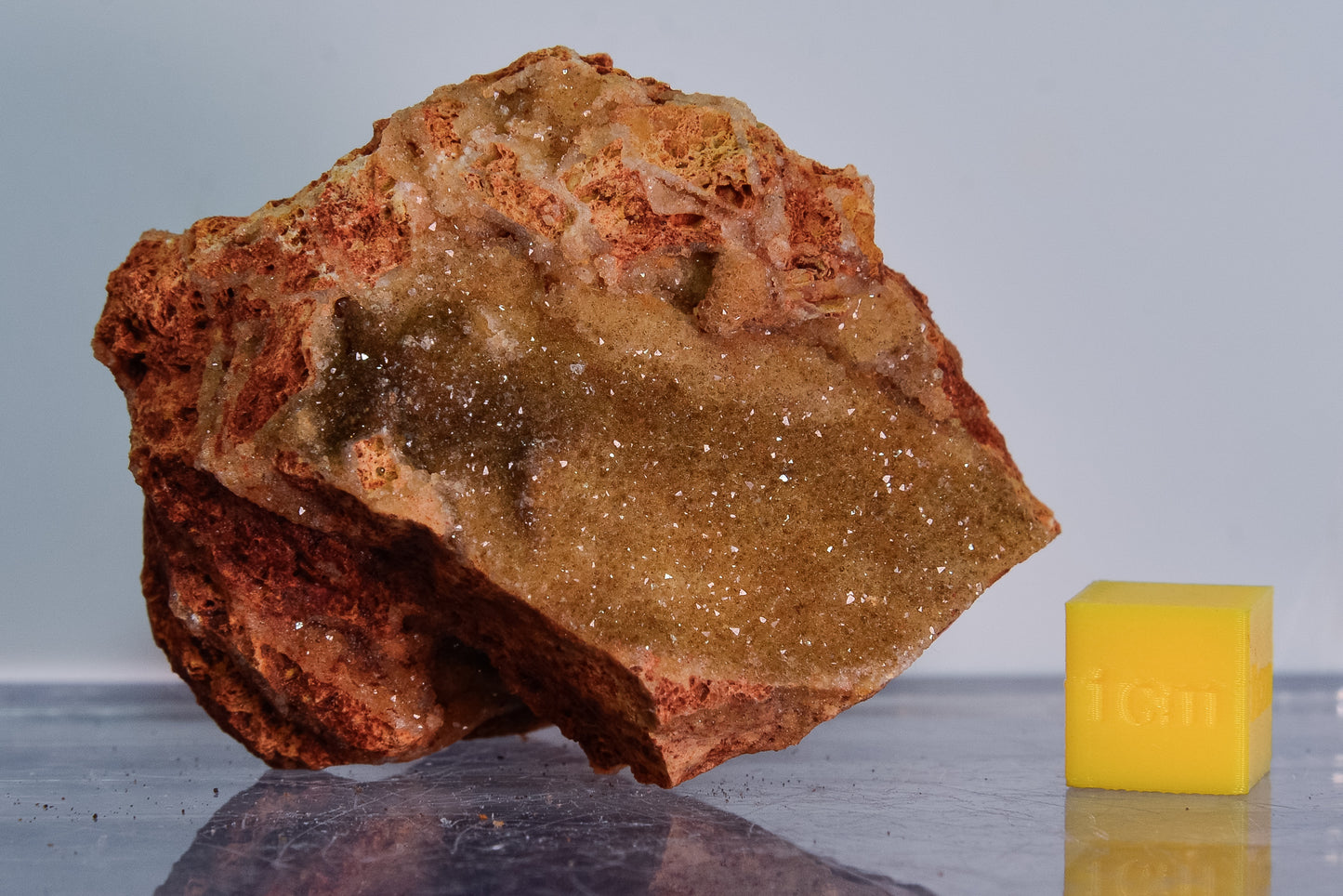
Boxwork Quartz Specimen (Zhejiang, China)
Boxwork Quartz Specimen (Zhejiang, China)
Couldn't load pickup availability
Boxwork Quartz Specimen - Xianyan Cave Temple (仙岩洞寺), Linghu Village (岭湖村), Qianqing Subdistrict (钱清街道), Keqiao District (柯桥区), Shaoxing City (绍兴市), Zhejiang Province (浙江省), China (中国)
The specimens from the Xianyan Cave Temple area are exceptional examples of what geologists call Boxwork Quartz, often referred to informally as "honeycomb quartz" due to its intricate, lattice-like structure. These pieces are not simply crystals that grew in this shape; rather, they are "mineral ghosts" that preserve the memory of a different mineral that has long since vanished. This formation began millions of years ago when hydrothermal fluids, rich in dissolved silica (SiO2), permeated the volcanic fractures of the Keqiao region. These fluids deposited layers of quartz over a primary "template" mineral—most likely bladed calcite (CaCO3) or baryte (BaSO4)—which had already crystallised into thin, intersecting plates.
As the geological environment shifted, the chemistry of the groundwater changed, becoming acidic enough to dissolve the softer calcite template but leaving the durable quartz shells intact. This process created the delicate, hollow "cells" or boxes you see in these photos. The interior of these boxes is often lined with a secondary growth of druzy quartz, consisting of thousands of microscopic crystal points that create a glittering effect when the specimen is turned in the light. This multi-stage formation is a hallmark of epithermal systems, where boiling fluids and cooling temperatures allow for the rapid precipitation and subsequent leaching of minerals.
The vibrant orange, ochre, and rust-red colors seen in your specimens are the result of iron oxide staining, primarily from minerals like limonite (FeO(OH)⋅nH2O) and hematite (Fe2O3). During the final stages of the stone's life in the mountain, iron-rich waters seeped into the hollow boxwork, leaving behind these mineral pigments. In the specific context of the Xianyan Cave locality, this boxwork quartz is highly significant because it demonstrates the intense hydrothermal "boiling" that occurred near the volcanic vents, providing a structural map of the ancient fractures that once carried mineral wealth through the earth.
Origin: Xianyan Cave Temple, Linghu Village, Qianqing Subdistrict, Keqiao District, Shaoxing City, Zhejiang Province, China 仙岩洞寺 浙江省绍兴市柯桥区钱清街道岭湖村 (30°08'39.2"N 120°22'14.9"E)
Mineral type: Quartz (SiO2)
Size: ~4-5(L) x 4(H) x 2(W) cm (see scale cube), 38 g
Share